At some point in growth and marketing, you face an uncomfortable reality: you have data, but it’s not useful.
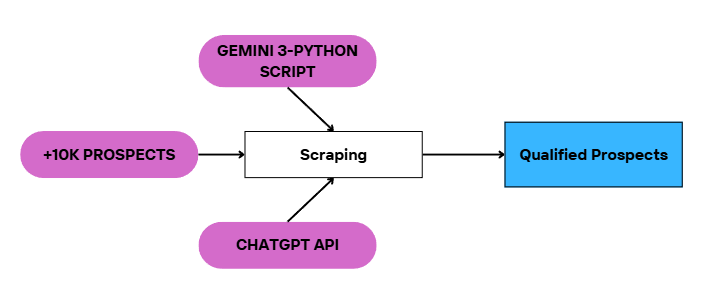
That’s exactly where we were. We had a large, messy list of contacts — mostly email addresses, phone numbers, and names. No company names, no industries, no segmentation. Just raw, unstructured information. On its own, this data was almost useless for targeted marketing or sales outreach.
Step 1: Extracting Signal from Noise
The first breakthrough was realizing that email domains are a hidden goldmine. Using a Python script, I:
- Extracted the company domain from each email address
- Normalized and cleaned domains (handling Gmail, Outlook, personal emails, etc.)
- Filtered out non-business addresses
This instantly transformed individual contacts into company-level entities.
Step 2: Website Validation & Industry Discovery
Once we had company domains, the next challenge was understanding what these companies actually do. For each domain, the script:
- Checked if the website was active
- Scraped key website signals (titles, meta descriptions, content keywords)
- Used an AI-assisted classification layer to assign a NAICS code to each company
This step was critical. Instead of guessing industries, we anchored every lead to a standardized industry taxonomy.
Step 3: NAICS-Based Lead Categorization
With NAICS codes assigned, we moved from “contacts” to structured market segments. Leads were categorized into:
- Core target industries
- Adjacent or expansion opportunities
- Out-of-scope industries (automatically deprioritized)
This allowed us to build industry-specific lead pools, align marketing messaging with real business contexts, and hand sales teams pre-qualified, relevant accounts. No more generic outreach. Every campaign now had a clear why.
Step 4: Creating a Business-Ready Lead Database
Finally, everything was stored in a structured database:
Contact → Company → Domain → NAICS → Business Relevance
It was fully searchable, scalable, and ready for CRM integration, ABM campaigns, or sales prioritization. What started as 10,000+ dirty prospects turned into a clean, categorized, and revenue-aligned lead system.
The Marketing Impact
This wasn’t just a technical exercise — it fundamentally changed how marketing and sales worked together. Key outcomes included:
- Higher email engagement due to industry-specific messaging
- Faster sales qualification
- Better alignment between marketing spend and revenue potential
- Reduced noise and wasted outreach
Most importantly, it shifted our mindset from volume-driven marketing to intent-driven growth.
Final Thought
Modern marketing isn’t about having more data. It’s about extracting meaning from imperfect data and turning it into action.
With the right mix of automation, AI-assisted classification, business logic, and industry standards like NAICS, even the messiest datasets can become a competitive advantage.
If you’re sitting on “dirty” leads — you might already be closer to growth than you think.