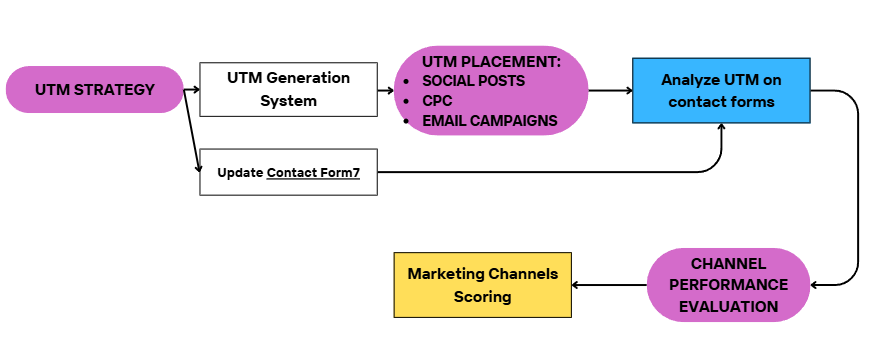
When I joined the company, digital marketing had activity — but no visibility. Campaigns were running across email, social, and paid channels, yet there was no reliable way to answer a basic question: Which channel is actually generating leads?
There were no UTMs, no consistent naming, and no scoring system. Every lead looked the same once it hit the inbox.
Step 1: Designing a Unified UTM Strategy
Before touching tools, I defined a single, unanimous UTM framework:
- Consistent naming conventions
- Clear rules for source, medium, campaign, and content
- Built to scale across email campaigns, social posts, and CPC
To avoid human error, I built a UTM generation system so UTMs were created systematically — not manually.
Step 2: Embedding UTMs into Lead Capture
Tracking traffic alone isn’t enough if the data disappears at the form level. I updated all Contact Form 7 (CF7) forms inside Elementor by:
- Adding hidden UTM fields directly into form codes
- Mapping UTM parameters from the URL to form submissions
- Updating notification emails to display UTM values clearly
Now, every lead submission carried its context: Source, Medium, and Campaign. No guessing. No spreadsheets. No “I think this came from LinkedIn.”
Step 3: Turning UTMs into Channel Intelligence
Once UTMs were flowing into contact forms, we could finally analyze real attribution:
- Which forms were converting better
- Which channels produced higher-intent leads
- How different campaigns performed beyond clicks
This enabled marketing channel scoring based on lead volume, lead quality, and downstream conversion behavior. Channels were no longer treated equally — they were evaluated objectively.
What Changed After This System?
The impact was immediate and structural:
- Clear visibility into lead sources
- Alignment between traffic, forms, and sales conversations
- Data-backed decisions on where to invest budget
- The ability to pause or double down on channels with confidence
Most importantly, marketing discussions shifted from opinions to evidence.
The Bigger Lesson
UTMs are not a reporting feature. They are infrastructure.
Without them, you can’t score channels, optimize intelligently, or prove marketing’s impact. With a unified UTM system embedded directly into lead capture, digital marketing stops being a black box and becomes a measurable growth engine.
Sometimes the biggest marketing wins don’t come from new campaigns — they come from finally knowing what’s working.