Agent frameworks such as OpenClaw represent a practical shift in automation: instead of asking an AI model for one answer, you give an agent a goal, tools, memory, and permission to work through a sequence of steps. That can be powerful for research, lead processing, content operations, code maintenance, reporting, and repetitive marketing workflows.
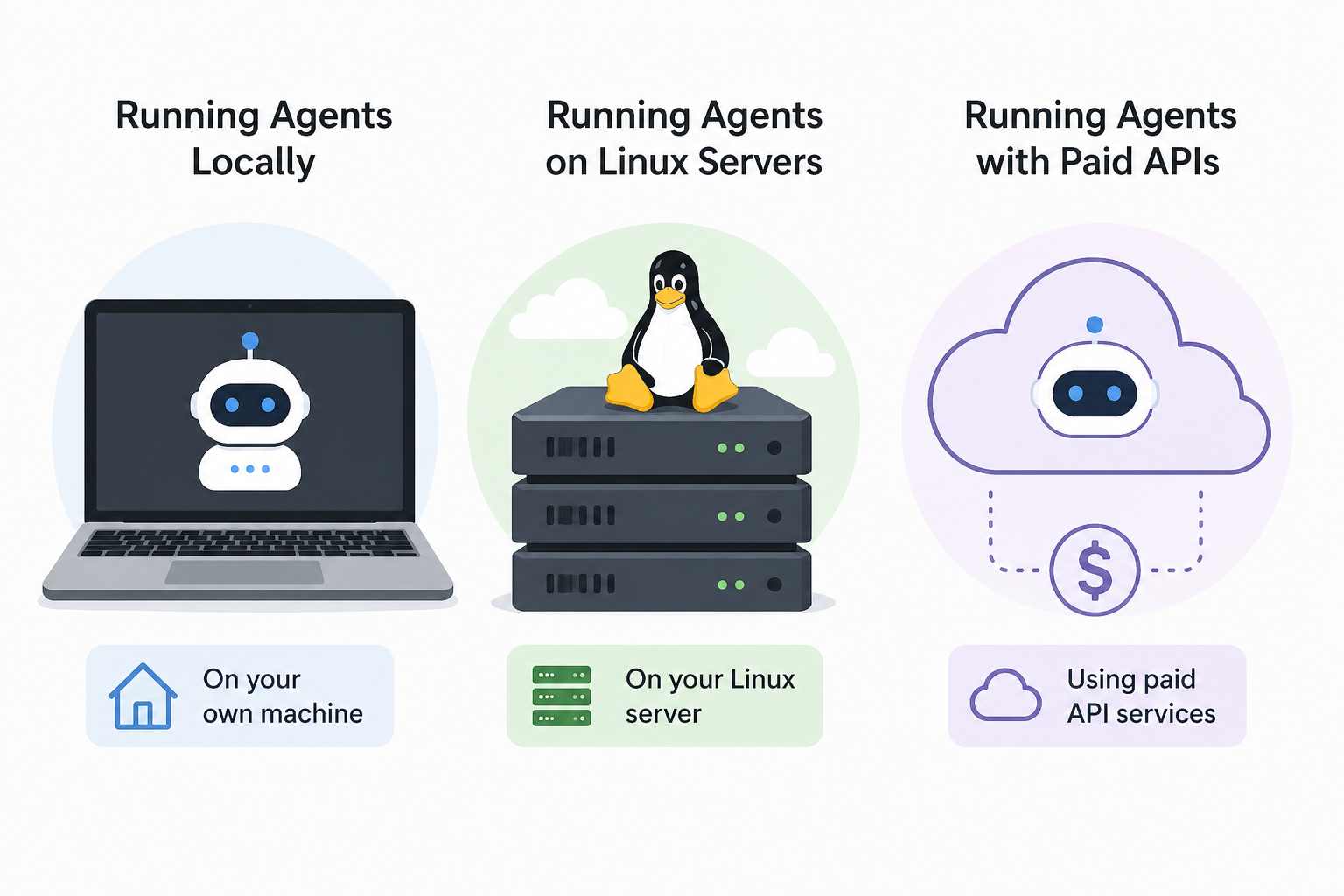
The important question is not whether agents are useful. The real question is where they should run: on a local machine with local models, on a Linux server, or through paid model APIs. Each option changes cost, speed, privacy, reliability, and maintenance.
1. Running agents locally with local models
A local setup gives the most control. The agent, model, files, and data stay on your own machine. For sensitive research notes, internal documents, private lead lists, and experimental automation, that privacy can matter.
- Pros: stronger privacy, no per-token API bill, offline experimentation, full control over model choice and system configuration.
- Cons: weaker reasoning than top paid models in many tasks, hardware limits, slower generation, setup friction, and more troubleshooting.
Local models are useful when the task is repetitive, data-sensitive, or structured enough that the model does not need frontier-level reasoning. They are less ideal when the agent must make complex judgments, write high-stakes content, or recover gracefully from ambiguous instructions.
2. Running agents on a Linux server
A Linux server is a strong middle ground. You can run the agent continuously, schedule jobs, connect databases, expose internal dashboards, and separate automation from your personal laptop. This is often the better architecture for serious business workflows.
- Pros: always-on execution, better scheduling, easier integration with databases and APIs, remote access, and cleaner production discipline.
- Cons: server security, deployment maintenance, monitoring, backups, dependency management, and possible GPU or hosting costs.
I like this path when automation becomes operational: daily reporting, enrichment pipelines, content checks, CRM hygiene, or monitoring tasks. A server creates discipline. It also creates responsibility.
3. Running agents with paid APIs
Paid APIs are usually the fastest way to get high-quality reasoning. They are easier to connect to agent frameworks, and they reduce the burden of managing model infrastructure. For business work, this often means faster prototypes and more reliable outputs.
- Pros: better reasoning, faster setup, strong tool support, no model hosting, scalable usage, and access to modern multimodal capabilities.
- Cons: recurring cost, data governance concerns, rate limits, vendor dependency, and the need to design prompts and workflows carefully to control spend.
Paid APIs make sense when the value of the task is higher than the usage cost. For example: executive summaries, advanced research, campaign planning, technical writing, and multi-step analysis usually benefit from stronger models.
My practical view
I do not see these options as enemies. I see them as layers. Use local models for privacy, repetition, and learning. Use Linux servers when the workflow becomes a repeatable business process. Use paid APIs when quality, speed, and reasoning matter more than infrastructure control.
The best automation stack is rarely the most impressive one. It is the one that saves time, protects the data, produces reliable output, and can be maintained without turning the team into full-time system administrators.