
In any modern business environment, your marketing and sales stack is fragmented across multiple channels. You send emails, reach out via social media DMs, capture website visitors, and run various outbound and inbound campaigns simultaneously. Each channel generates its own stream of interactions: responses, objections, approvals, and, more often than not, ambiguous signals that fall somewhere in between a clear "yes" or "no."
To manage this complexity, automation becomes essential. You start by deploying task-specific agents: one for contact extraction, another for social media outreach, others for cold email, lead qualification, and so on. Each agent handles a defined workflow efficiently.
However, as your volume of interactions grows, so does the number of agents. And with that growth comes an exponential increase in generated data: messages, responses, behavioral signals, and operational logs. At a certain point, your system reaches a paradoxical state: automation saturation.
This is where ROI begins to decline, not because your automation is ineffective, but because you can no longer keep up with the volume of data it produces. The bottleneck shifts from execution to oversight.
Enter the Agent God
To resolve this, you introduce a higher-order system: a supervisory agent, what I call the Agent God.
This is not just another task-specific agent. It operates at a meta level with broader system access and authority. Its responsibilities include:
- Orchestrating all subordinate agents
- Managing workflows, schedules, and dependencies
- Aggregating and interpreting outputs across systems
- Filtering signal from noise in large-scale interaction data
- Optimizing token usage and controlling operational costs
- Maintaining overall system performance and stability
In essence, it is an agent that manages agents.
Why This Layer Matters
Without a supervisory layer, your system becomes fragmented and inefficient at scale. With it, you gain centralized intelligence, coordination, and cost control. The Agent God transforms a collection of independent automations into a cohesive, adaptive system.
Security Considerations
With increased authority comes increased risk. A supervisory agent has access to sensitive data, cross-system controls, and decision-making power. This makes security architecture non-negotiable.
Key considerations include:
- Strict access control and permission scoping
- Audit logging for all agent-level decisions and actions
- Data encryption across all pipelines
- Isolation of critical workflows to prevent cascading failures
- Continuous monitoring for anomalous behavior
In short, the more powerful your orchestration layer becomes, the more deliberate your security design must be.
A Real Snapshot
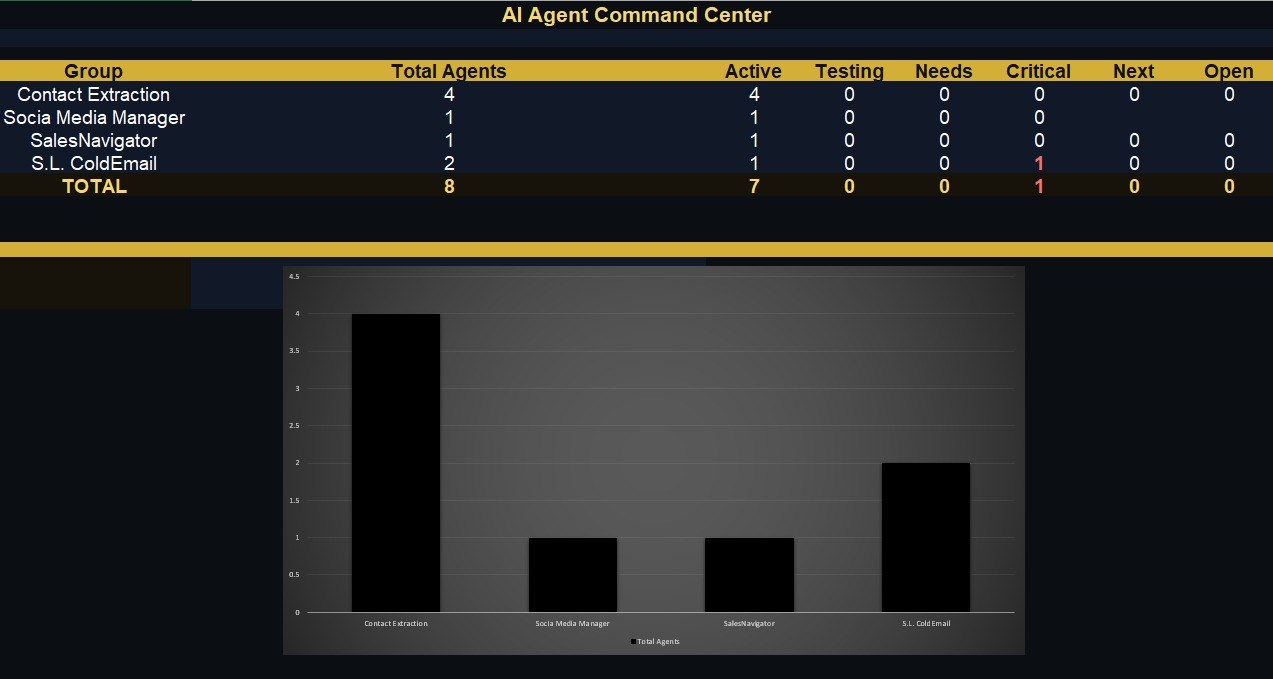
The dashboard shown above reflects my system just two weeks after implementing agents. Even at that early stage, multiple agents were already active across different functions. Since then, the system has scaled significantly, bringing both increased capability and increased complexity.